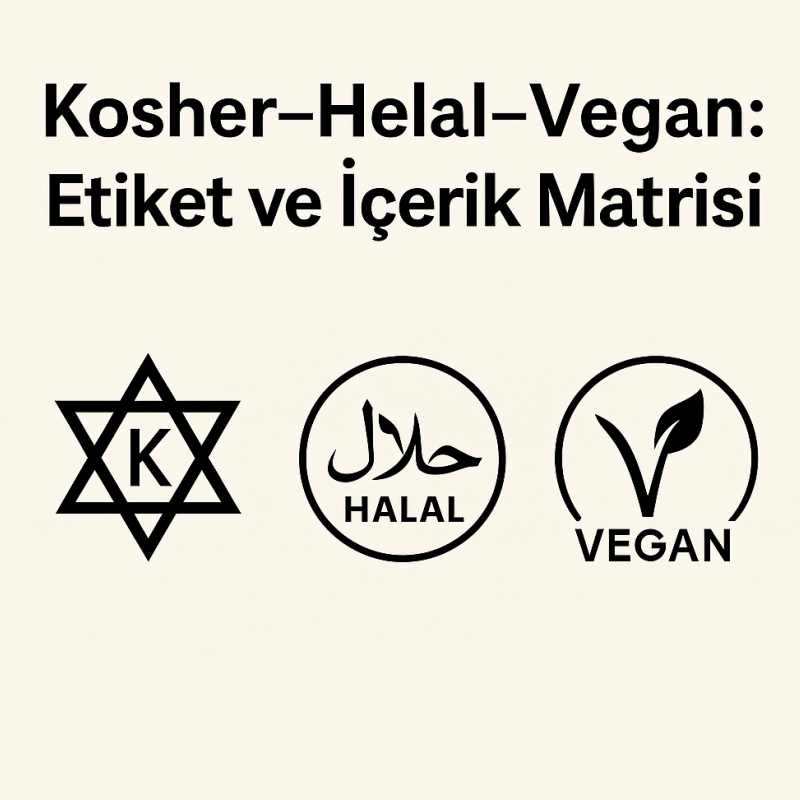
Kosher–Halal–Vegan: Label and Content Matrix
In the global food market, ensuring that products are labeled in accordance with religious, ethical, and lifestyle expectations is critical not only for regulatory compliance but also for brand reputation. Kosher, Halal, and Vegan certifications directly influence product development, supply chain management, and marketing strategies.
This section introduces the core parameters of the Kosher–Halal–Vegan label matrix, including comparative coverage analyses, raw material classification, production line cleaning requirements, and labeling strategies for multi-certified products.
Comparative Coverage Analyses
Kosher, Halal, and Vegan certifications impose different requirements in terms of product content, production processes, and labeling criteria. On a corporate level, it is essential to map these differences clearly and determine which requirements are critical for specific markets.
| Criteria | Kosher | Halal | Vegan |
|---|---|---|---|
| Animal-Based Ingredients | Permitted for specific species (e.g., ruminants) | Only products from animals slaughtered according to Islamic law | Completely prohibited |
| Additives | Evaluated based on origin | Must be Halal-certified | Must be free from animal origin |
| Alcohol Use | Limited allowance in some contexts | Strictly prohibited | Generally prohibited |
Such comparative analyses enable companies to identify both compatible and risky parameters in product formulation, making strategic decision-making more efficient.
Raw Material and Additive Classification
One of the most critical steps in Kosher, Halal, and Vegan labeling is the proper classification of raw materials and additives. This includes not only main ingredients but also auxiliary substances such as flavors, enzymes, stabilizers, and colorants.
Important Note
For multi-certified products, the same additive may be acceptable under one certification but not under another. For example, gelatin may be accepted by certain Kosher authorities but is not permissible under Halal or Vegan standards.
Cleaning and Line Separation Criteria
Compliance with Kosher, Halal, and Vegan standards requires more than selecting the right ingredients. When different product categories are processed on the same production line, strict cleaning and separation procedures become mandatory.
In Kosher certification, production lines must undergo "kosherization," which involves sterilization with hot water or steam. For Halal production, it is critical to eliminate all traces of pork derivatives and alcohol. Vegan certification requires complete prevention of contact with any animal-derived products.
- Kosher: Equipment must be sterilized with high-temperature water or steam.
- Halal: Any doubtful residues must be removed using a triple-wash process.
- Vegan: Complete line separation is required to prevent cross-contamination.
These rules protect not only the validity of the certification but also ensure long-term consumer trust.
Labeling Strategies for Multi-Certified Products
It is possible for a single product to hold Kosher, Halal, and Vegan certifications simultaneously. In such cases, the placement and presentation of certification logos must be carefully planned, since each certification has its own specific requirements.
Label designs must include essential details such as the certifying body, registration number, and validity period. Transparent and standardized labeling builds consumer confidence and minimizes disputes during inspections.
Strategic Tip
When displaying multiple certifications, ensuring that logos are presented at equal size and visibility reinforces the brand’s neutrality and transparency.
Harmonizing Supplier Declarations
One of the biggest challenges in managing Kosher, Halal, and Vegan compliance is standardizing supplier documentation. Different suppliers may present conflicting information about ingredients, additives, or processing methods.
To mitigate risks, companies should require updated certifications from suppliers on a regular basis and archive them in a centralized digital repository. This practice not only streamlines audits but also prevents potential discrepancies.
- Document Validity: Certifications should be renewed annually.
- Language Consistency: For international markets, English translations should be mandatory.
- Source Verification: The accreditation of the certifying body must always be verified.
Laboratory Test Requirements
In certification processes, relying solely on supplier declarations is insufficient. For Kosher, Halal, and Vegan labeling, laboratory testing may be required to verify that products are free from prohibited substances. These tests are especially critical for high-risk additives or products with potential cross-contamination.
Analyses typically focus on detecting alcohol, porcine derivatives, animal-based enzymes, or milk proteins. Conducting tests in internationally accredited laboratories ensures that the results are both legally valid and accepted by certification bodies.
Key Point
Laboratory testing should not only be performed during certification but also integrated into ongoing internal audit programs.
Communication and Claim Management
Consumer trust is built not only through certification logos but also through transparent communication. Misuse or misleading claims about Kosher, Halal, or Vegan status can result in legal penalties and reputational damage.
Companies must regularly review packaging, websites, and promotional content to ensure accuracy. Additionally, they should establish an internal mechanism to respond quickly to public inquiries or regulatory challenges.
- Transparency: Clearly share certifying bodies and their credentials.
- Crisis Management: Implement recall procedures promptly if mislabeling is discovered.
- Media Relations: Use press releases to restore consumer trust during disputes.
Ready-to-Use Customer FAQ Bank
Customer questions about Kosher, Halal, and Vegan certifications are common and require structured answers. Establishing a centralized FAQ bank improves customer satisfaction and minimizes the risk of inconsistent or misleading responses.
The FAQ bank should cover topics such as ingredient origins, production methods, certifying bodies, and supply chain transparency. Customer service teams must be trained to use these responses consistently across all communication channels.
Best Practice
Publishing and regularly updating FAQs on the company website allows customers to access accurate information directly.
Product Lifecycle Changes
Any change in a product’s lifecycle — such as a new raw material source, modifications in production methods, or switching suppliers — can directly affect the validity of Kosher, Halal, and Vegan certifications. Therefore, lifecycle management is critical for maintaining compliance and long-term certification sustainability.
Failure to report changes to certification bodies in a timely manner may result in market withdrawal, loss of sales, or legal consequences. A proactive change management system helps companies assess risks in advance and maintain certification integrity.
- Raw Material Changes: Verify that all new ingredients are properly certified.
- Supplier Changes: Immediately request updated certificates from new suppliers.
- Production Technology: Ensure new equipment complies with cleaning and segregation standards.